
.Wattco offers boiler heaters that suit many different sizes and dimensions that customers need. If a boiler has a flanged heater that need to be replaced, Wattco can replicate the model you currently have from practically any manufacturer and have your boiler system up and running in a matter of hours. Boiler heaters come in a variety of different flange sizes and lengths. The two common models are rounded flanges and square flanges. The lengths of the boiler heater is highly correlated to the length that is available within your boiler. If all the major variables are known (ie. Wattage, Voltage, Length and Flange size), Wattco can replicate the model you have in no time.
Boilers are used in many facilities for comfort heating, laundry services, and kitchen services. The nature of the facility's operations will indicate whether the boiler system is steam generating or if hot water system is used. Hot water systems typically heat up water up to 230 degrees Fahrenheit. The operating pressure for hot water systems is approximately 30 psi to 125 psig (hydrostatic).
There are many different types of steam and hot water boilers. Low pressure steam boilers are limited to 15 psig are are predominantly used in common heating practices such as comfort heating. High pressure boilers are used for more intense applications and can have up to 1000 psig.
Electric boilers are extremely popular as they are considered the most efficient method of heating water or steam and, the are clean, quiet and easy to install.Because there is no carbon emissions, electric boilers have very low maintenance costs with easily replaceable electric heating element (flange heaters). Government regulated bodies are enforcing more often, the use of electric boilers to meet carbon emission standards that are being enforced as a result of the carbon footprints of fossil fuels. In areas where the cost of electric power is favorable, electric heating is considered the best choice as it offers power ranges of 5KW up to 3,000 KW of output power.
Flanged industrial immersion heaters are commonly used in many chemical, petroleum and water based applications. Consisting normally of an ANSI rated flange with several hairpin elements or bugle tubular elements extending from the face of the flange, this electric heater uses direct heat application to the liquid medium. A thermowell is often used within the bundle of elements to allow for a probe (either a thermocouple, RTD or basic mechanical thermostat) to relay temperature readings to a digital controller that cycles and maintains the desired target temperature. Often a high limit sensor is also used to help protect liquid mediums from over heating and, offers protection to the flanged heater as well.

Wattco flanged immersion heaters allow the flexibility of using many different alloys to help resist corrosion and maintain life longevity of the flanged heater. Steel flanges are typically used for lubricant oils, heavy and light oils, waxes as well as mildly corrosive liquids and low flow gas heating. Process water, soap and detergent solutions as well as demineralised or deionised water applications often use steel flanges. Stainless steel flanged heating elements are used with mildly corrosive solutions as well as severe corrosive solutions. Food applications also use stainless steel for sanitary purposes. The sheath materials used can be steel, stainless steel, copper as well as exotic alloys such as inconel, hastalloy and titanium. Extremely corrosive environments such as salt water should use exotic alloys such as titanium to avoid sheath breach over excessive durations. Industries that use exotic alloys can include military, chemical and process industries.
Screw Plug heaters from WATTCO™ consist of hairpin tubular elements that are brazed or welded into a machined pipe thread fitting, (normally an NPT fitting for North American standards) which are then screwed directly through a threaded coupling in the tank wall or vessel, or installed in pipe. Screw plug heaters are an easy way to heat up solutions in smaller containers that also require controls. Mechanical thermostats or Digital controllers can be used with these immersion heaters to help reach target temperatures with great accuracy meeting your project objectives. Additional thermowells can be installed for high limit temperature probes to help protect your liquid and processes.

Screw Plug heaters from WATTCO™ are used for heating gases and liquids in tanks or vessels. These elements are designed to be immersed in liquid so that heat transfer will occur at a rapid rate, enabling quick heat up times. Typical uses include the food and beverage industry, laboratory clinics, applications involving hydraulic oils and lubricants as well as more sophisticated uses such as heating up flammable liquids or gases which require explosion proof housing.
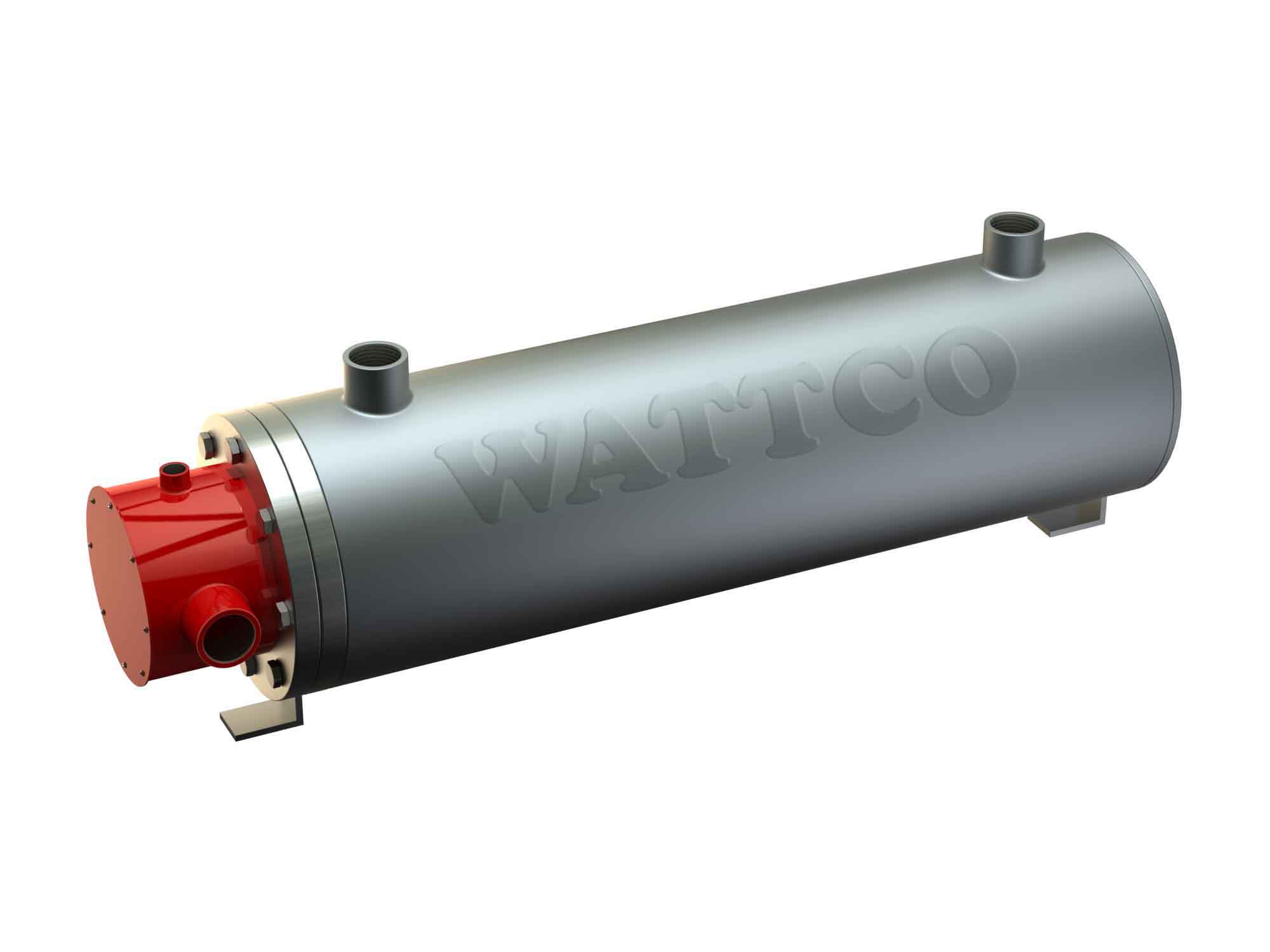
Circulation Heaters also known as "in line heaters" use steel, stainless steel, titanium flanged immersion heaters in many applications. Lube oil and waste oil applications often use steel for circulation heaters as it is fairly inexpensive compared to stainless steel counterpart. In line heaters flowing water use stainless steel, admired for its anti corrosive qualities. Both applications involve using a pump that flows the liquid through a closed pipe circuit (IE. water or glycol solution) that is reheated. A major consideration for this application is viscosity. Heat that is generated by the oil heater allows the liquid to be viscous enough to pass through the circuit of pipes. Circulation heaters come in a range of watt densities that are specifically designed for the medium that is heated. The required wattage to heat the oil or water is highly correlated to the flow rate (in GPM). The oil or water enters through an inlet (the inlet closest to the flange heater) and gets heat applied to it as it flows within a vessel chamber and exits the outlet nozzle (or flange) where it circulates throughout the piping circuit. Insulation is often required for vessels in order to preserve the heat to be applied within the vessel. Efficient heat application can often reduce unnecessary costs through heat loss. Digital thermocouple probes or RTDs, can be used with the electric immersion heater to maintain the oil or water at the preferred temperature. Many applications use liquids with low flash point and, require explosion proof housing (NEMA 7) to avoid potential mishaps.

Other useful features found with circulation heaters are drain valves. They can be installed in any location on the vessel and allow for easy maintenance of the heater. The water or oil can be purged through the drain valve allowing for maintenance on the elements. Calcium deposits and other residue can be found on elements and should be cleaned several times a month. Inline heaters also come with the choice of horizontal or vertical mounting depending on your application. Skid mounted vessels are used in oil heating industries that require mobility. Wattco heaters are also available in moisture resistant terminal boxes or explosion proof terminal boxes for hazardous environments. Wattco in line heaters are an exceptional choice for heating process liquids, non corrosive to the materials of construction. In line gas heaters are also used when heating closed loop systems that require high temperatures of up to 1000 deg F. These applications use large flanged vessels that contain the gas and heat it up in containment most efficiently requiring low maintenance and excellent heat transfer.
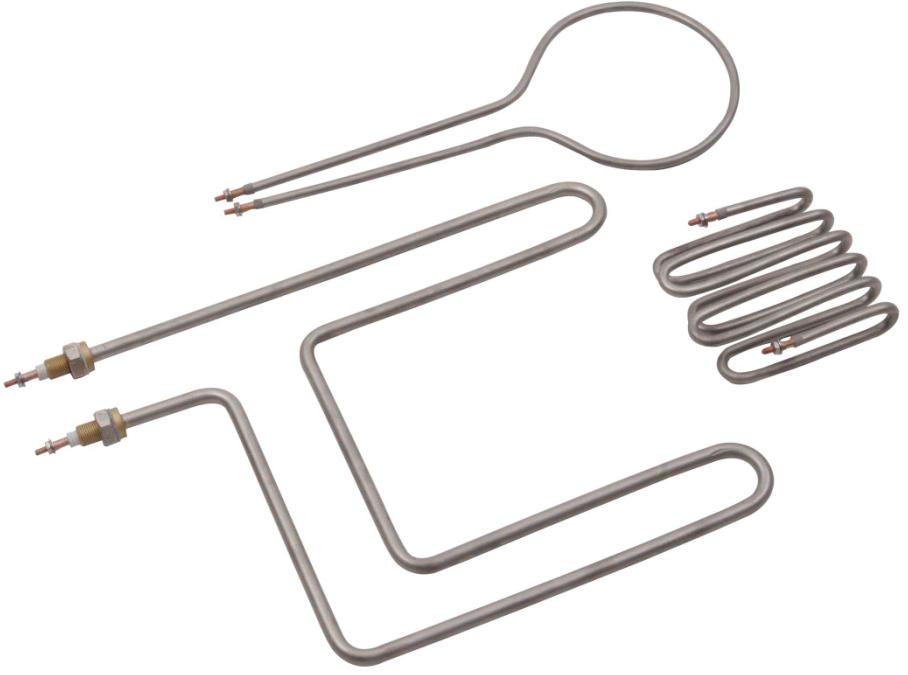
Over the Side Heaters are a popular product for economic and practical uses. Using a water-resistant terminal housing, these industrial heaters come in many shapes and sizes to fit within your tank dimensions and specifications. Wattco over the side heaters are custom designed with multiple tubular elements and a thermowell to hold your temperature probe. Shaped to fit within your standard (or non-standard tank) the economic feasibility meet the budget of any project manager. These mobility of these heaters to be able to be used in more than one container allow it to be the choice of many project managers. Wattco uses high quality stainless steel and other exotic alloys to meet the requirements of any application. Together with a digital controller, this heater becomes the perfect solution to heating large containers with no access to the liquid except from the top. Brackets are used to support the heater onto the wall of the tank and cold sections are carefully calculated to prevent over heating when water or liquid levels drop below certain levels as a result of evaporation or drainage. Using high quality alloys, Wattco over the side heaters are strong enough to physically withstand many harsh environments both indoors and outdoors. Commonly used in petroleum and chemical industries it is an exceptional choice for projects with limited budgets
Strip heaters, often considered component heaters, are a simple way of using surface area to transfer heat effectively. Steel strip heaters are an excellent heat transfer product and can be easily controlled by using either mechanical thermostat ot cost effective bimetal thermostats that can be installed on the surface you are heating. Mounting holes are useful to mount the heaters securely on almost any surface with terminal extending from the sheath for easy electrical connections. Many users also request lead wires that extend from one end that make the installation more flexible as the temperature controller is easily adaptable to this configuration.
Temperatures reach as high as 500 degrees F and use the high quality magnesium oxide that is used in tubular elements that allow for effective heat transfer. A fairly inexpensive way of heating surfaces or small areas, strip heaters are an excellent solution to meet any budget.
Strip heaters are composed of a heating element, a protective sleeve or sheath, and mounting hardware. If strip heaters are used as a radiant heater, they have can have fins to maximize surface area and heat transfer to the air. Strip heaters can be clamped or bolted onto objects or solid surface contact heating over large areas and are primarily used in indoor applications.
Finned strip heaters, often considered component heaters, are a simple way of maximizing heat intensity and surface area to transfer heat effectively in an area. Steel fin strip heaters are an excellent heat transfer product and can be easily controlled by using either mechanical thermostat ot cost effective bimetal thermostats that can be installed on the surface of the heater. Mounting holes are useful to mount the heaters securely on the wall housing with terminal extending from the sheath for easy electrical connections. Many users also request lead wires that extend from one end that make the installation more flexible as the temperature controller is easily adaptable to this configuration.
Temperatures can reach as high as 500 degrees F and use the high quality magnesium oxide that is also used in tubular elements that allow for effective heat transfer. A fairly inexpensive way of heating small areas, finned strip heaters are an excellent solution to meet any budget.
Finned strip heaters are composed of a heating element, a protective sleeve or sheath, and mounting hardware along with steel fines that are used to extend surface area. If strip heaters are used as a radiant heater, or a duct heater, they have can have fins to maximize surface area and heat transfer to the air. Strip heaters can be clamped or bolted onto objects or solid surface contact heating over large areas and are primarily used in indoor applications.
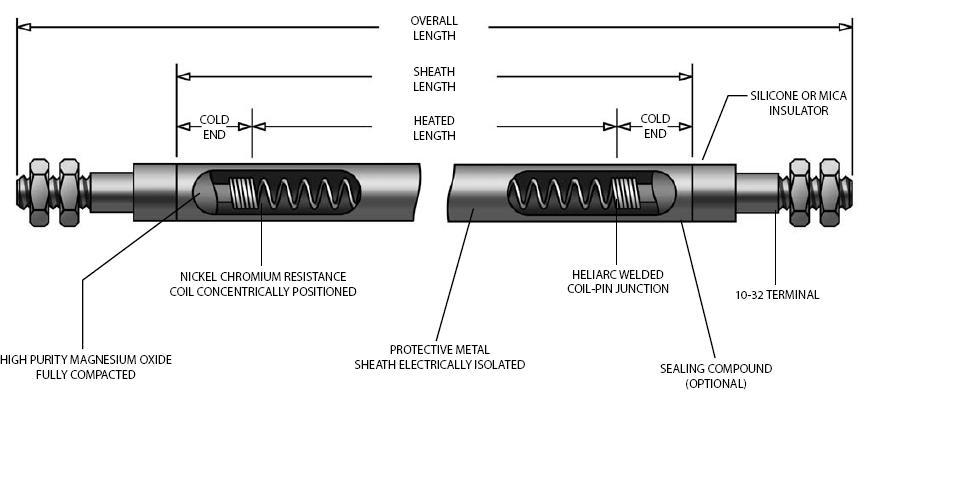
Cartridge heaters can be considered "component heaters" that are used to heat up many different applications. Primarily used in mould, these heaters fit snug inside a cavity and helps heat solids by reaching high temperatures. Cartridge heaters have the veratility of being able to carry thermocouple inside to help control temperatures of the heater more accurately. Various diameters allow for it to be used in any cavity and can be custom designed with any cold section. Lead wires extend from the end to your controls. Cartridge heaters are used in bag sealing applications, hydraulic oil applications, motor oil applications, gear boxes, water based applications as well as laboratory and food equipment. Sheaths can reach extreme temperatures as cartridge heaters can be designed with higher watt densities. High watt density cartridge heaters also have the ability of having different types of lead wire connections. For more mechanical processes, stainless steel braided leads are used against mechanical stress. BX cabling can be used for added protection however it reduces the lead wire flexibility. Terminal pins are also available on all models. Cartridge heaters from Wattco are made of a swaged construction that consists in a high-grade nickel chromium resistance wire wound around a high-quality MgO core that is centered in a stainless steel casing.
Cartridge heaters are used for heating metal parts and can also be fitted with threaded bushings for liquid heating for certain applications. Cartridge heaters will reach metal temperatures of up to 1,400ºF (760ºC) with the appropriate material, watt density, and fit selections (see Figure 2 on our catalog page 7.2).
WATTCO Band heaters can be found in several types of dimensions, wattages, voltages and material. Mica band heaters are an inexpensive form of heating that surround pipes and tubes that require external indirect heating. Pipe heating, drum heating, barrel heating normally used for oils, lubricants,or any other circular applications. Band heaters use electric heating (NiCr wire) to heat up the external surface of drums or pipes for a gradual heat transfer. Band heating is an indirect form of heating and offer safety when heating volatile explosive substances as well as pipes or containers that cannot otherwise be heated using direct heating methods. Industrial band heaters can be made with NEMA 1 terminal boxes or NEMA 4 moisture resistant terminal boxes that protect terminations and have the option of a thermostat or thermocouple digital controllers to help control and regulate an applied heat. Insulation is also required to help direct the heat to your application rather than experience heat loss, and slower heat up time.

Band heaters from WATTCO are the ideal solution for high watt densities and high operating temperature applications, especially for the plastics industry. The various types of band heaters available at WATTCO include mica insulated band heaters and ceramic band heaters.
Silicone rubber heaters from WATTCO™ are composed of fiberglass reinforced silicone rubbers that are moisture and chemical resistant. Thin and flexible, silicone rubber heaters are designed to meet the requirements of various low and medium temperature applications that require irregular shapes, sizes, and dimensions. Known for its unique flexible properties, silicone heaters can withstand mechanical shock and vibration. Silicone heaters consist of two "wafers" of silicone with a heating resistor sandwiched in between. Thermostat controls are options that are used to help reach your target temperature. Teflon lead wires exit any location of your choosing and are offered at any length you require. Perfect for applications that require direct heat such as surfaces, barrels, conical shapes as well as in cylinders and small areas where traditional electric heaters cannot fit. Adhesive backing is also available to help with fixation. Silicone heaters are used in applications requiring up to 450 degrees F such as freeze protection of electrical enclosures. and are known for its unique qualities such as a high dielectric strength, non-toxic, and flame retardant.
Open coil elements are the most efficient type of electric heating while at the same time, being the most economically feasible for most heating applications. Used predominantly in the duct heating industry, open coil elements have open circuits that heat air directly from the suspended resistive coils. Fast heat up times also improve efficiency while being designed for low maintenance and easily, inexpensive replacement parts.
Open coil heating elements from Wattco are typically made for duct heating, forced air & ovens and for pipe heating applications. Open coil heater elements are made to fit inside standard 2’’ or 3’’ schedule 40 NPS pipe. Open coil heaters are used in tank and pipe heating and/or metal tubing. A minimum clearance of 1/8’’ is required between the ceramic and the inside wall of the tube. Installing an open coil element will provide excellent and uniform heat distribution over a large surface area.
Open coil heater elements are an indirect heating solution to decrease watt density requirements or the heat fluxes on the surface area of the pipe connected to the heated section and prevent heat sensitive materials from coking or breaking down.
Wattco's duct heaters come in various sizes and dimensions to fit any compartment. There are three types of duct heaters available: open coil, tubular or finned tubular heating elements that are either flanged or inserted in the duct. Air duct heaters are primarily used in air flowing ventilation systems and comfort heating applications while process duct heaters are mainly used for industrial process heating applications (ovens that require re-circulated air or forced circulation).
Wattco designs and configures your electric duct heaters according to your specifications. Our team is dedicated to research and development of the latest technologies, while striving to meet every customer’s needs by manufacturing high quality duct heaters. Since 1969, WATTCO has expertise in developing and manufacturing electric duct heaters that make Wattco duct heaters, the most easily adaptable solutions for most non-pressurized, air-heating systems.
A broad range of custom built electric duct heaters with capacities up to 1000kW is available upon request. WATTCO™ heaters can be used for applications with the following voltages:
• 347 volts/1 phase
• 600 volts/1 phase
• 600 volts/3 phases
• 208/240 volts/1 phase
• 208 volts/3 phases
WATTCO™ duct heaters have the international, American recognized, Canadian Standards Association (CSA us) label, which set the standards for the electric heating industry. Duct heater can include proper built-in safety devices to extend the service life of the heater.
WATTCO™ also manufactures heaters for industrial processes, original equipment manufacturers (OEM) or any other special applications.
Wattco Infrared radiant heaters are economic, efficient, and clean. Infrared radiant heaters are designed for comfort heating applications that require radiant heat in indoor, outdoor, and exposed areas through direct infrared heat transfer. Used in large areas such as arenas, sawmills, ice rings, gymnasiums auditoriums, racetracks, parking garages, aircraft hangars and large areas that require radiant heating, infrared heaters use tubular heaters that reach high temperatures and radiate sufficient heat from overhead. Infrared heaters are also used in the food industry to maintain food at target temperatures for periods of time. Infrared heaters come in many different lengths and sizes and are an excellent choice for outdoor applicaitions. Waterproof housing is available to help protect terminals from humidity and moisture penetration and, are used in conjunction with digital or mechanical controls. Wattco infrared heaters use high grade stainless steel throughout along with protective wiring to help maintain lifelong usage.
Installation of infrared heaters are simple and in the event that tubular elements need to be replaced, they are available at economically feasible prices.
Control panels are used to regulate temperature and provide safety mechanisms in place to prevent overheating your liquid and protect your heating elements. Control panels come in many different terminal boxes - standard NEMA 1 terminal boxes, dust proof boxes, waterproof boxes and explosion proof boxes for hazardous areas. Digital controllers are used to display ambient and target temperatures of your solution. They contain contractors, relays, fuses, on - off disconnect switches, and other components to help regulate your Wattco heater in a safe environment. In conjunction with thermocouples or RTD sensors, control panels are the "brains" of the system and determine the heat intensity of your heaters. Control panels are typically available for heaters generating at least 30 Amps to over 200 Amperes. Special accommodations can be made for systems that are over 200 Amperes. NEMA 4 terminal boxes are typically used for outdoor applications where concerns of moisture and humidity is a factor. Flow switches can also be used for circulation heaters. All Wattco control panels come with circuit schematics as well as support documentation that might be required for configuration purposes.
Industrial immersion heaters are a fast and efficient way of heating up various liquid solutions in processing equipment, large tanks and containers in many industries. Heating up liquids using direct heat transfer allows for the liquid medium to quickly reach the desired temperature using electric heaters such as flanged heaters, screw plug heaters, over the side heaters or circulation heaters. This application is commonly used in chemical processes, large petrochemical containers as well as large water containers that require fast heat up time. With minimal maintenance requirements, immersion heaters are an excellent solution to rapid heating in almost any industrial environment.
Flanged heaters have the ability to hold multiple hairpin elements that can be mounted onto the side of a metal tank. Its versatility allows it to offer up to 750 KW of power on a single unit. Among its various uses include utility companies, defense contractors, petrochemical researchers and boiler manufacturers.

Circulation heaters (or In Line Heaters) use immersion heaters such as flanged heaters or screw plug heaters within a vessel chamber to heat up liquids from an inlet and expels the heated liquid through an outlet using the force of a pump to allow easy circulation. The circuit of running liquid is then reheated to reach a target temperature. It is often referred to as the most efficient use of electric heating as heat is initially applied to liquid at ambient temperature but then recirculated at an elevated temperature that does not require as much energy to reach your target temperature. The use of insulation around piping and the tank itself allows the heat to be contained. The circulation vessel is often reinforced with high quality insulation that helps prevent heat loss. Coupled with the use of a high quality alloy that prevents heat loss (high grade stainless steel) the unit is a complete system that allows users to use thermocouples, RTD temperature sensors or standard mechanical thermostats to maintain liquids at optimum temperatures. Safety sensors are also available such as high temperature sensors to help prevent excessive heat or over temperatures. This protects both the liquid you are heating as well as protection to your flanged heater.

The use of electric immersion heaters has been more popular in the past several decades as rising costs of fuels force individuals to select a more cost efficient way of heating their applications. Ecologically conscientious groups have long advocated for cleaner energies to help save the environment. Electric heating has been known to be the cleanest form of heating leaving no residual discharge and provides immediate heat transfer to any medium. Over the side heaters are used to heat up larger containers of liquid that have openings.
WATTCO™ Pipe Heaters are especially constructed to fit inside standard 2 or 3” schedule 40 NPS pipes. Specifically designed to fit in tank applications that require extremely low watt densities such as waxes, thick liquids such as tar, molases and corrosive mediums. Wattco pipe heaters do not come in contact with the liquid medium. Rather the indirect heating from element to pipe is used to heat liquid sources. This provides easy maintenance as the tank does not need to be emptied out if heater needs to be replaced.
Designed to withstand high heat environments, Wattco pipe heaters are an excellent choice to use with heavy bunker fuel oils, corrosive liquids and liquids with high viscosity. Wattco pipe heaters can use flanged heaters, screw plug heaters as well as resistance coil heaters (open coil heaters).

Pipe heaters use supportive ceramics resistant to high thermal heat that provide mechanical support to coils. Thermocouples can also be used to relay temperature readings to a digital controller that helps regulate the heat intensity. Steel pipes can be used for their thermal transfer properties and their corrosion resistant properties to many petrochemical solutions. Open coils are the most efficient type of electric heating while at the same time being the most economically feasible for most heating applications.