

Contact the Wattco expert team for engineered HVAC solutions designed for data centers. We help optimize temperature control, efficiency, and reliability for critical operations.
HVAC for Data Centers
Data centers today are the backbone of global commerce, communication and artificial intelligence (AI) in our world of digital information. Unlike commercial buildings, where the HVAC system is designed for human comfort, the HVAC system in a data center is considered a “mission-critical utility” that protects sensitive IT equipment. High-performance servers produce massive amounts of heat while processing data; therefore, if the heat isn’t removed from the server quickly and effectively, it can result in hardware thermal throttling, destroy hardware, and/or cause hardware catastrophes.
The HVAC system in a data center must operate with a 99.999% uptime rate and function 24 hours per day, and 365 days per year. As of 2026, the amount of workloads associated with AI has increased rapidly, resulting in a shift from cooling the entire room to implementing specific cooling methods (high-precision) for high-density thermal management to accommodate the extreme heat generated from modern Graphics Processing Units (GPUs) and specialized processors.
HVAC for Data Centers: Cooling vs Comfort Cooling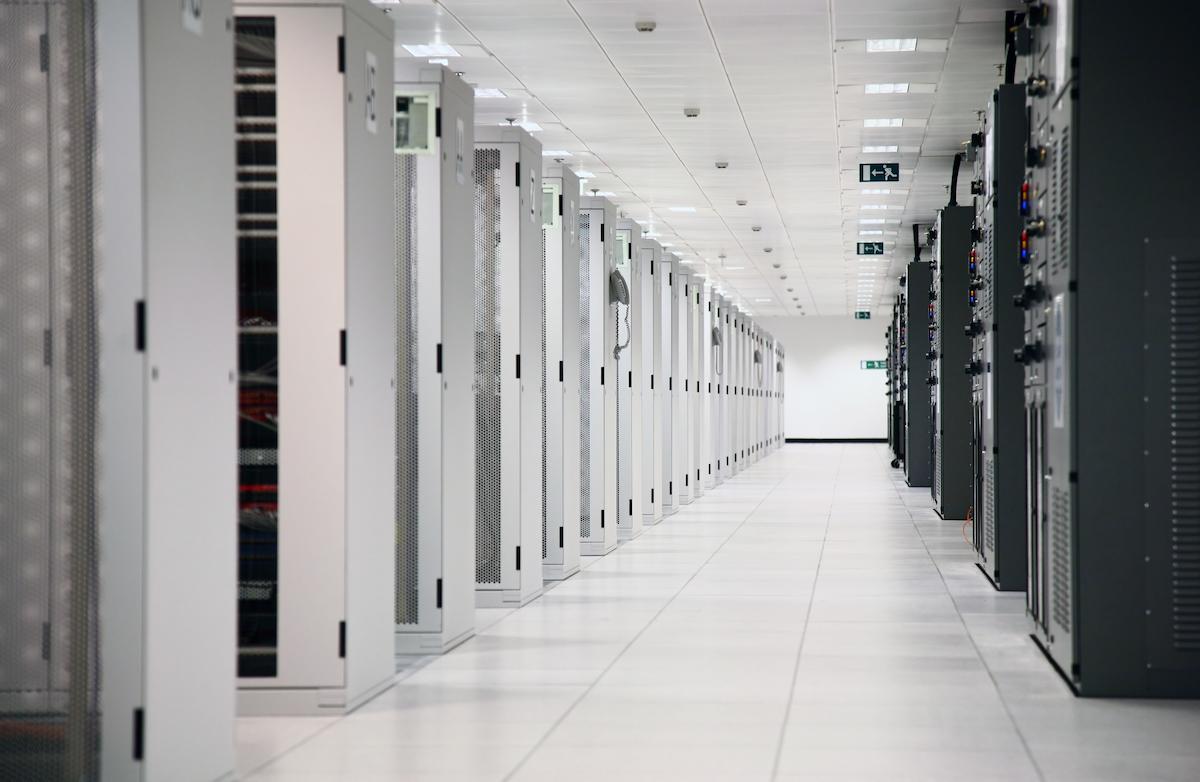
A fundamental distinction in HVAC for data centers design is the use of precision cooling rather than standard “comfort” air conditioning. While a residential or office AC unit focuses on cooling the air to a level comfortable for people, precision cooling is engineered for the unique thermal profile of electronics.
Sensible Heat Ratio (SHR)
Data centers produce “sensible heat”—heat that changes the temperature of the air without changing its moisture content. Precision systems have a very high SHR (often 0.90 to 0.99), meaning nearly all their cooling capacity goes toward lowering temperature. Comfort systems spend up to 40% of their energy removing humidity (latent heat), which can lead to air becoming too dry in a server room.
Operational Intensity
Operational intensity for comfort systems typically see around 1200 hrs annually in a business and summer month scenario. Data center systems operate continuously for over 8700 hours annually.
Airflow Velocity
Airflow velocity through precision units moves much larger volumes of air at higher velocities, therefore, ensuring that heat (produced from tightly packed server components) has time to be removed or “scrubbed” prior to accumulating as dangerous hot spots.
Core Cooling Technologies and Components
Data centers vary greatly in terms of specialized equipment used to maintain stable environmental conditions. Technology selection is often based on facility size or server rack density since different types of cooling are better suited for each.
Computer Room Air Conditioning (CRAC)
CRAC units function similarly to conventional air conditioners, however they are designed specifically for high duty cycles. CRAC units operate using Direct Expansion (DX) refrigeration cycles; air is blown over cooling coils filled with refrigerant to cool down the air in the data center. Small to medium-sized data centers typically utilize CRAC units.
Computer Room Air Handler (CRAH)
Hyperscale Data Centers prefer CRAHs because of their ability to handle large-scale thermal loads efficiently. Instead of refrigerants, CRAH units utilize chilled water supplied from a central plant for operation purposes.
Chillers and Cooling Towers
The central plant typically houses chillers that cool the water used by the CRAH units. Cooling towers eliminate excess heat absorbed by buildings and release it to the outside. Many of today’s 2026 cooling tower designs include economizers (free cooling) which use lower temperature outside air or water to cool the building while it is permissible to operate with no energy-hungry compressors operating.
Airflow Management and Containment Strategies
Producing cold air is not enough; precision delivery of the cold air to IT infrastructure is essential. Inadequate airflow management results in cold supply and hot return air mixing which forces HVAC to work harder and wastes energy.
Hot Aisle / Cold Aisle Layout
The industry standard is to arrange server racks in rows so that the “fronts” (intakes) face each other and the “backs” (exhausts) face each other. In the data center, alternating “cold aisles” are provided for the supply of fresh (cold) air and “hot aisles” are provided for the collection of hot exhaust air.
Containment Systems
To further improve efficiency, physical barriers are used to seal the aisles.
- Cold Aisle Containment (CAC): The cold aisle will be physically contained with a ceiling and doors to ensure that all of the chilled air in the cold aisle must pass through the servers.
- Hot Aisle Containment (HAC): The hot exhaust collected in the hot aisle is captured in a physically contained area and directed back to the return vents of the AC unit. This system is also more efficient as the ambient temperature of the entire data center will be comfortable.
The Rise of Liquid Cooling for AI Workloads
In 2026, the heat density of individual server racks has climbed significantly due to the hardware requirements of Artificial Intelligence. Traditional air cooling often reaches its physical limit at around 20 kW to 30 kW per rack. To handle loads exceeding 50 kW, data centers are increasingly adopting liquid cooling.
Direct-to-Chip Cooling
Liquid cold plates come into direct contact with the CPU or GPU, using water (or another fluid) to cool the chips by evaporating heat more efficiently than air.
Immersion Cooling
Complete server blades are submerged in a chemical dielectric which absorbs heat when evaporated and then is circulated back through a heat exchanger. Using chemical gears for cooling eliminates fans and significantly reduces the noise produced or energy consumed by the fan.
Heat Reuse
As a result, data centers are now capturing high quality waste heat generated from liquid cooled systems and using it to heat other nearby buildings or to heat or wash industrial waste products that would otherwise be wasted. This creates an opportunity for companies to recover valuable resources from their data center operations that would have been previously wasted.
Humidity and Contamination Control
Maintaining the correct temperature control is only half the battle. Data center HVAC must also strictly regulate humidity and air purity.
Humidity Management
If the air is too humid, moisture can condense on circuits, causing shorts. If it is too dry, static electricity can build up, leading to electrostatic discharge (ESD) that can fry sensitive components. Most facilities maintain a relative humidity between 40% and 50%.
Air Filtration
Servers do a great job at sucking in air; they are like super powerful vacuum cleaners. HVAC systems must use high-efficiency filters (such as MERV 11 or higher) to remove dust and gaseous contaminants that could cause corrosion or “clog” the tiny heat sinks inside the servers.
Conclusion
The HVAC system of a data center is the foundation of its operational uptime. As computing power continues to scale, the focus has shifted from simple refrigeration to intelligent, high-density thermal management. With the emerging deployment of precision cooling techniques, advanced containment procedures and most recently, liquid cooled technology, data center managers can protect their expensive investment in IT systems while decreasing energy consumption. As data continues to become one of the world’s most important commodities, and the cooling that supports the flow of that data becomes increasingly critical.