

Industrial Heater Quote: What Engineers Should Know
You already know the process needs heat. That part’s obvious. But the moment you fire off a quote request, it turns into a back-and-forth, what fluid, what temperature, what voltage, how big is the tank, what controls, and the quote you wanted last week is suddenly days away. I’ve watched this happen more times than I can count, and almost always the holdup isn’t the manufacturer being difficult. It’s that the request landed without enough of the application behind it. A good quote really does start with good information, so here’s a plain rundown of what’s worth having in front of you before you contact an industrial heater manufacturer.
Engineers should know before requesting an industrial heater quote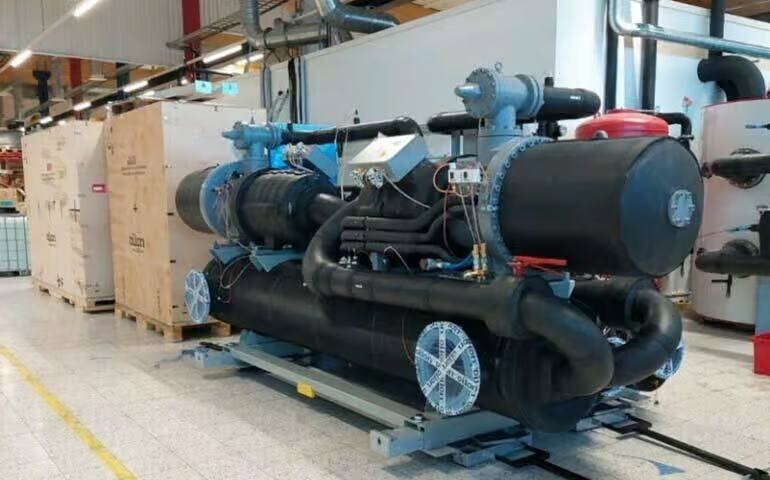
It’s tempting to open with “I need a 30 kW heater” and leave it there, but the right heater comes out of what the process actually has to do, not just a kW figure or whatever the budget allows.
Get the application clear first, and the specification tends to fall into place. Skip it, and you’re guessing, and so is whoever’s quoting you.
What material or fluid is being heated?
The medium changes almost everything. Water behaves nothing like heavy oil, and a corrosive chemical asks for very different materials than a clean process liquid. Gases are their own case again. The medium changes almost everything. Water behaves nothing like heavy oil, and a corrosive chemical may require a very different industrial immersion heater configuration than a clean process liquid.
So it helps to say plainly what you’re heating, along with a sense of how thick or viscous it is, whether it’s corrosive, and whether it’s the sort of fluid that degrades if it gets too hot in one spot. Those traits feed straight into the heater design and the materials that go into it.
What temperature does the process need to reach?
Three numbers matter here, and people often give only one. There’s where the fluid starts, which might be a cold tank in an unheated building in winter, there’s the target you’re trying to hold, and there’s the maximum the process can safely tolerate. Handing over all three lets the manufacturer size the heating requirement properly instead of working backward from a single figure and hoping.
How quickly does the process need to heat up?
This is the detail that surprises people, because heat-up time can swing the whole sizing. Bringing a given volume up to temperature in two hours needs a far bigger heater than doing the same job over eight. Same fluid, same tank, same target, and yet the capacity you need can look completely different, all because of the clock. So the very first thing to pin down is how fast the process truly has to reach temperature, since that one answer moves the kW around more than nearly anything else does.
Heat-up load vs holding load
Two different numbers hide in here, and they’re easy to mix up. First there’s the heat-up load, which is the energy it takes to lift the process from cold all the way to temperature. Then there’s the holding load, a much smaller, steady draw that just tops up the heat escaping while it runs. Both matter when you’re sizing correctly. Quote off the holding load alone and the heater will crawl to temperature. Size everything around a fast heat-up and you may be oversized for normal running. A good spec accounts for both.
The manufacturer have a clear picture of the tank or system
A heater doesn’t live in isolation, so it can’t be selected well without knowing where and how it’s going to work.
Tank size, volume, and insulation
Dimensions and working volume are the starting point, but the ones people forget are insulation and the surrounding conditions. A well-lagged tank indoors loses heat slowly, while a bare tank outdoors in a cold, windy spot bleeds it constantly, and that lost heat has to be replaced by the heater. So the more you can say about tank size, how full it actually runs, what insulation is there, and the ambient conditions around it, the closer the sizing will be.
Is the process static or flowing?
Heating a still tank is a different job from heating fluid on the move through a pipe or a circulation loop, and the manufacturer needs to know which you’ve got. For anything flowing, the flow rate and the operating pressure become key details, since the heater has to raise the temperature of fluid passing through in whatever time it spends against the elements.
Leave those out and a flowing application can’t really be quoted. If the process requires continuous heating while fluid moves through the piping system, inline heaters can provide direct electric heating while maintaining the required flow rate and process temperature.
Confirm the electrical requirements early
Electrical supply tends to get treated as an afterthought, sorted out near the end, and yet it can directly change the heater configuration. Nailing it down early saves an awkward redesign later.
Voltage, phase, and available power
Give the voltage, say whether the supply is single-phase or three-phase, include the frequency, and be honest about how much electrical capacity the facility can actually spare. A heater spec that assumes power the site hasn’t got is no use to anyone, so the aim is to match the specification to what the plant can realistically deliver rather than what you’d like it to have.
Watt density and material selection matter more than they seem
There’s more to it than total power. A pair of things that come across as small print, the watt density and the sheath material, end up having a big say in how reliable the heater is, how kindly it treats your fluid, and how many years it gives you.
Why watt density matters?
Watt density is basically how much heat is packed onto each bit of the element’s surface. Push too much heat into too small an area and, depending on the fluid, you can get coking, scaling, or the fluid breaking down right at the element. Watt density becomes especially important when specifying tubular heaters, because the element diameter, sheath material, power rating, and available surface area all influence how concentrated the heat is at the heater surface. For something like a heat-sensitive oil, a lower watt density spread over more surface keeps the fluid happy and the heater alive far longer. It’s one of those choices that never shows up in a kW number but shows up plainly in how the heater ages.
Choosing the right sheath material
The sheath is what stands between the element and your fluid, so it has to get along with that fluid. Stainless steel suits plenty of ordinary jobs, Incoloy handles higher temperatures and tougher conditions, and there are other options once corrosion or chemical compatibility comes into play. You don’t need to arrive with the metallurgy solved, but flagging anything corrosive or unusually hot up front lets the manufacturer steer you to a sheath that’ll actually survive the application.
Think about installation and controls before the quote
A heater might tick every box in the spec and still cause you grief if no one worked out how it mounts, where it’ll physically sit, or how it gets controlled. Raise that stuff early and you keep the nasty surprises away from the install.
How will the heater be installed?
There are a few common routes, flanged, screw plug, over-the-side, and circulation heaters, and the right one depends on your tank or system and how you’ll get at it. Where cutting a new opening into the tank isn’t practical, over-the-side heaters can be installed from the top and are particularly useful when easy removal, inspection, or maintenance is important. Mounting location, the space you’ve actually got, and access for maintenance all matter, so it’s worth sharing them. A heater that fits the process but won’t fit the space, or can’t be pulled for servicing, isn’t really the right heater.
How will temperature be controlled?
Control belongs in the spec from the outset, not stuck on at the end. Some jobs are fine with a plain thermostat, while others want thermocouples or RTDs wired into a digital controller, along with over-temperature protection so things stay safe if a reading ever goes wrong.
Some applications are fine with a basic thermostat, while others require thermocouples or RTDs connected to temperature control panels for more precise monitoring, control, and protection of the heating system. Decide roughly what level of control the process needs early, because it belongs in the heater spec from the start rather than being figured out once the heater’s already built.
The information engineers should have ready before requesting a quote
If you work in chemical, petrochemical, oil and gas, or anything similar, there’s one more thing to sort before you ask for numbers, which is whether the heater sits in a hazardous location. The exact requirement varies, maybe a Class or a Division, a Zone, a NEMA rating, ATEX or IECEx, or a rule that’s peculiar to your own project, and whichever it is, put it on the table straight away, since it runs through the entire build and there’s no tidy way to add it to a plain quote after the fact. This isn’t meant to be a full guide to hazardous areas, only a reminder to bring it up sooner rather than later. That said, here’s a checklist you can keep nearby:
- Material or fluid being heated
- Tank or system size
- Working volume or flow rate
- Starting and target temperatures
- Required heat-up time
- Operating pressure, if applicable
- Voltage and phase
- Heater mounting preference
- Sheath material or compatibility requirements
- Temperature-control requirements
- Hazardous-area classification, if applicable
- Insulation and ambient conditions
Bring most of that and a manufacturer like Wattco can turn your request around quickly and accurately, rather than spending a week prising the details out of you one email at a time.
Common mistakes that slow down an industrial heater quote
The delays are nearly always the same handful of gaps. Someone sends only the desired kW and nothing about the fluid, so the sizing can’t really begin. Heat loss gets overlooked, so the number comes back short of what the real conditions demand. Voltage goes unconfirmed and the whole configuration has to shift later.
Installation space isn’t mentioned until the heater won’t physically fit, and hazardous-area requirements surface right at the end, after a standard unit’s already been quoted. None of these is complicated to avoid, and heading them off early saves real time for your engineering team and the manufacturer both, which is the whole point of getting the request right the first time.
FAQs about an industrial heater quote
What information should I provide when requesting an industrial heater quote?
Talk about the process itself, not only the heater you had in mind. Mention the fluid going in, how large the tank or system is, the working volume or the flow rate, the temperature you’re starting from and the one you have to reach, and how soon you need to be there. Layer on the voltage and phase, how you’d rather mount it, whatever controls you’re after, and any hazardous-area details that apply. Hand over more of this and the quote comes back both faster and closer to right.
How is the required heater kW calculated?
It really comes from two things added together, the energy to bring your fluid up to temperature in the time you need, and the energy to hold it there against ongoing heat loss. Your volume, the size of the temperature rise, the heat-up time, and the losses through the tank walls and out into the surroundings all feed into it. That’s the very reason the fluid, the timing, and the insulation details carry so much weight when you want an accurate figure.
Why does watt density matter when choosing an industrial heater?
Because total power isn’t the whole story. Watt density is how concentrated the heat is on the element surface, and pushing too much into too small an area can cause coking, scaling, or fluid breakdown with sensitive media. Nail it and you’re protecting both the quality of your fluid and how long the heater survives, which is why it’s worth as much thought as the headline kW.
What voltage and electrical details should be included in the RFQ?
Pass along the supply voltage, whether it runs single-phase or three-phase, the frequency, and a straight answer on how much electrical capacity the site can really give you. It’s worth locking down early, because the configuration has to sit within what the facility can actually deliver, and sorting it now saves a rethink once you’re well into the project.
When should hazardous-location requirements be mentioned?
Right at the start, before any numbers get quoted. If the heater sits in a chemical, petrochemical, or oil and gas environment, the relevant Class, Division, Zone, NEMA, ATEX, or IECEx requirements shape the entire build and can’t be tacked on cleanly at the end. Raising them early saves everyone from re-quoting a standard unit that was never going to be compliant.
Industrial facilities rely on the right heater to improve process efficiency, recover energy, and protect critical equipment. Contact Wattco to discuss your operating conditions and discover a customized heating solution for your application.