

What are Flanged Heaters?
WATTCO develops and manufactures a series of flanged immersion heaters used for heating gases and liquids such as: water, oil, and corrosive solutions. WATTCO flanged heaters have hairpin or bent tubular elements. They are manufactured by welding or brazing these heating elements onto a flange.
ANSI rated flange, usually made of steel, is ideally suited for industrial process heating. However other materials such as stainless steel are also used. The sheath materials used in heating elements include: steel, stainless steel, copper, and INCOLOY.
What are flanged heaters?
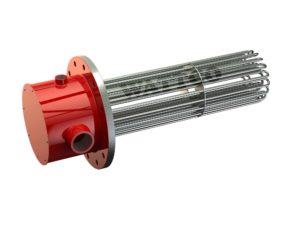
For process temperature control, WATTCO provides a thermowell–located among the heating elements bundle–with a sensing bulb inside. Flange heaters are installed on a tank or vessel wall using a companion flange.
Application of flanged heaters
The primary use of flanged immersion heaters is in process heating, specifically for heating gas and liquids in storage tanks, oil containers, food process equipment, and cleaning and rinsing tanks. The direct immersion method is an efficient process.
The flanged heater is usually installed are by bolting it to a matching flange welded to the tank wall or nozzle. The maximum sheath temperature of the element material is a very important parameter. It depends on: 1) viscosity 2) specific density and 3) corrosive properties of the heated medium 4) contaminants present, if any, in the heated medium 5) corrosion resistive properties of the sheath material. 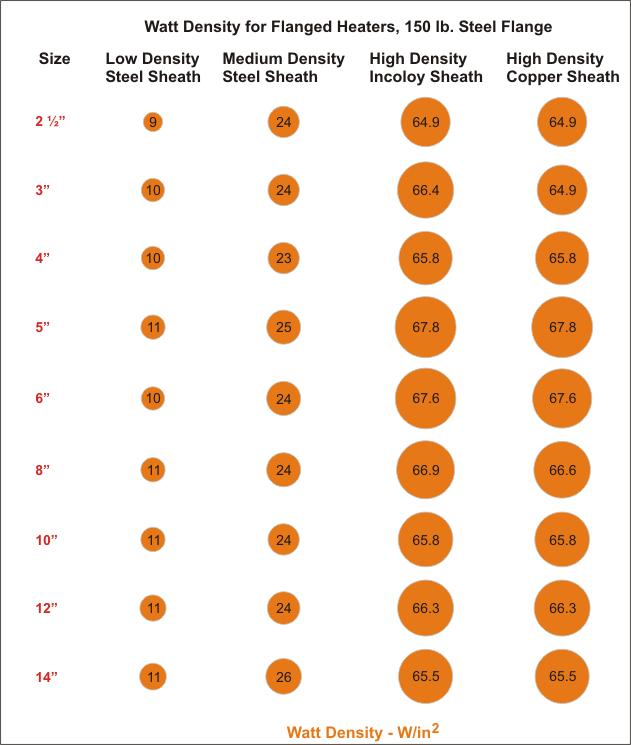 Figure 1: Typical watt density for flanged heaters. Refer to the datasheet for accuracy.
Temperature Monitoring and Control
For flanged heaters, temperature monitoring and control is provided by either mechanical or electronic devices. For temperature control using a mechanical device, the heater housing consists of a thermostat that operates as an on-off temperature control. This thermostat is factory installed.
The thermowell is comprised of a sensing bulb that is capable of transmitting the temperature readings to a digital temperature controller to keep the temperature to a desired setting. A thermocouple is placed inside the thermowell for an electronic-based mechanism of temperature control. The thermocouple is factory installed and is connected to a temperature controller.