

How Industrial Heating Systems Improve Manufacturing Productivity
Ask a plant manager where their hidden losses come from, and heating rarely makes the first list. It should. When industrial heating runs poorly, the damage spreads everywhere. Production takes longer because equipment crawls up to temperature. Batches come out inconsistent because the heat wanders. Energy bills climb. And every so often a heater fails and takes the whole line down with it. None of it shows up as one big obvious problem. It just quietly bleeds productivity, shift after shift.
Flip that around, though, and a well-designed heating system becomes one of the easiest productivity wins on the floor. Better process control, steadier quality, lower energy use, less downtime. Let me walk through how modern industrial heating actually moves the needle, and where the common traps are.

What Are Industrial Heating Systems?
At the simplest level, an industrial heating system is equipment built to generate or transfer heat during a manufacturing process. Usually that means converting electricity into thermal energy, then delivering that heat into whatever the process needs warmed.
And the range of what needs warming is huge. Heating liquids in tanks and vessels. Warming gases and process air. Keeping storage tanks and pipelines at temperature. Heating the air inside ovens and dryers.
Bringing molds, dies, and production equipment up to their operating point. Pretty much anywhere a process depends on hitting a specific temperature, there’s an industrial heater doing the work behind the scenes. Once you start looking, they’re everywhere in a plant.
Key Ways Industrial Heating Systems Improve Manufacturing Productivity
So how does better heating translate into more output? A few connected ways, and they stack on top of each other.
Faster Heat-Up and Shorter Production Cycles
Time spent waiting for heat is time you’re not making product. A properly sized heater reaches operating temperature faster, cuts down the startup delay at the beginning of a shift, and shortens the heating portion of every batch or process cycle.
The details matter here. Get the wattage right for the load and you have enough power to heat quickly without waste. Get the watt density right, the heat output spread across the element surface, and you transfer energy efficiently without cooking the medium. Place the heater well, and design for effective heat transfer, and the warmth goes where it’s needed instead of leaking away. Nail those, and you shave minutes off every cycle. Multiply that across a full production run and it adds up to real extra capacity.
More Accurate and Consistent Temperature Control
Speed only helps if the temperature holds steady once you get there. Consistent heat is what makes a process repeatable, so batch number 500 comes out the same as batch number one.
That consistency comes from the control system. Thermostats and thermocouples sense the actual temperature, sensors feed data back continuously, and control panels or automated temperature-management systems adjust the heater to hold the setpoint tight. Good control keeps the process inside its window instead of drifting, which cuts the variation between batches that quietly wrecks quality. When every run behaves the same way, you spend less time fixing problems and more time producing.
Reduced Equipment Downtime
Every unplanned shutdown is expensive, and a failed heater is a classic cause. Durable, application-specific heating equipment fails far less often, which means fewer maintenance interruptions and fewer surprise stoppages.
The trick is matching the heater to the job from the start. Proper material selection, choosing sheath and construction that suit the medium and environment, keeps corrosion and premature failure at bay. Preventive maintenance catches wear before it becomes a breakdown. And heater protection systems, like flow switches and over-temperature cutoffs, stop small faults from destroying the element. A heater built and protected for its actual conditions just keeps running, and a line that keeps running keeps producing.
Improved Product Quality and Lower Rejection Rates
Uniform heating is the difference between hitting spec and scrapping a batch. When heat is even, the product stays within its required parameters. When it isn’t, you get defects.
Think about what uneven heating does. Overheating degrades or warps the product. Cold spots leave it under-processed. Temperature swings during a run produce inconsistent results you can’t sell. All of that becomes scrap, rejected product, or rework, and every one of those is lost time and money. Steady, uniform heat keeps the whole batch within spec, so less goes in the reject bin and less has to be redone. Quality and productivity turn out to be the same conversation.
Lower Energy Consumption and Operating Costs
Energy is one of the biggest ongoing costs of any heating process, so efficiency here goes straight to the bottom line. Efficient electric heating systems deliver heat directly into the process, immersion heaters sitting right in the fluid, for example, so very little energy is wasted along the way.
Several things push efficiency up. Good insulation keeps the heat you paid for inside the process. Accurate temperature controls stop the heater from overshooting and burning excess power. Staged heating lets you use only the capacity you actually need at any moment. Proper sizing avoids the waste of an oversized unit. And reducing heat loss across the whole system means less energy in for the same result. Add it up and the same production runs on noticeably less power.
Industrial Heating Solutions Used in Manufacturing
Different jobs call for different heaters. Here are the main types you’ll find doing the work on a factory floor.
Immersion Heaters for Heating Liquids
When you need to heat a liquid, nothing beats putting the element right in it. Immersion heaters transfer heat directly into the fluid, which makes them extremely efficient since almost none escapes.
They come in a few styles for different situations. Flanged immersion heaters bolt into a tank or vessel for higher-power duties. Screw plug versions thread into smaller openings. And over-the-side heaters drop in from the top, handy when you can’t penetrate the tank walls or need to keep the bottom clear. You’ll see them heating water, oils, and chemicals, warming storage tanks and process vessels, and providing freeze protection for fluids that can’t be allowed to solidify.
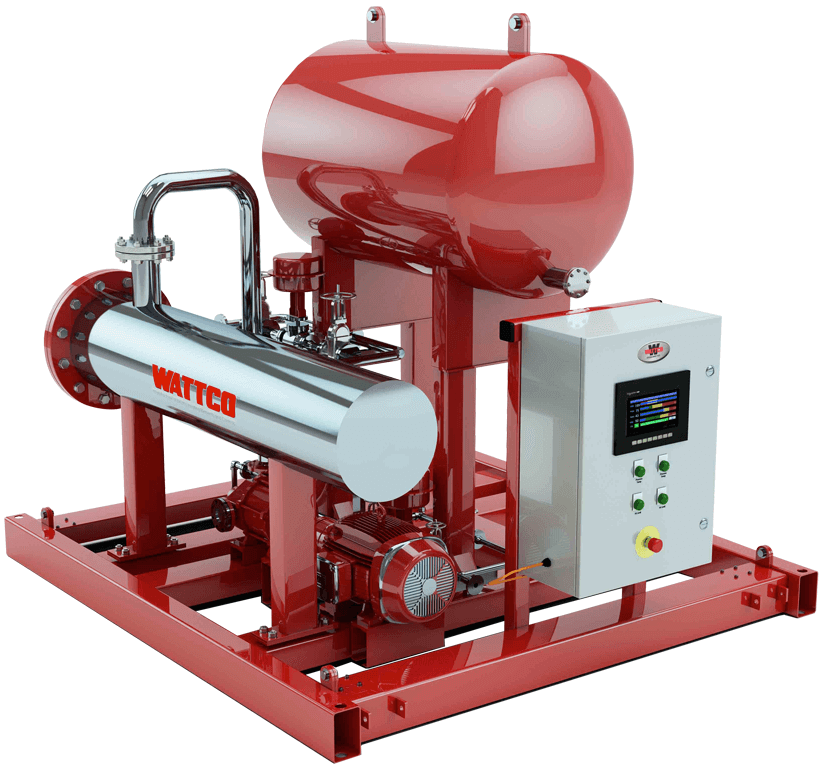
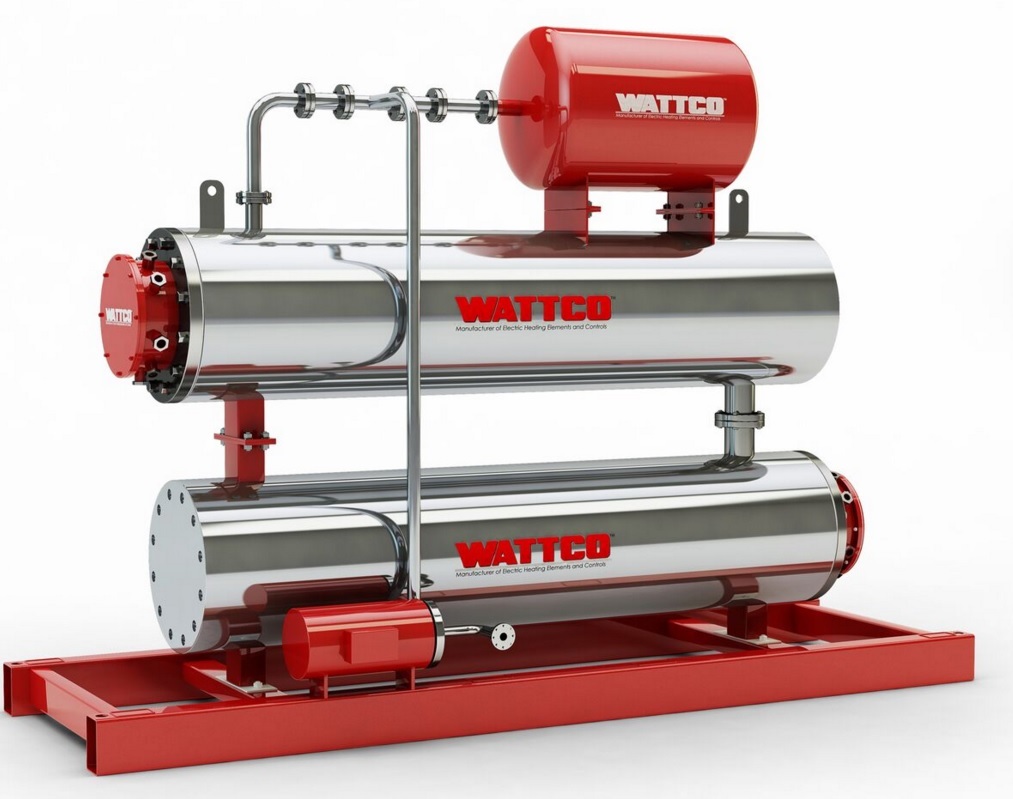
Circulation Heaters for Continuous Processing
For processes where the fluid is always moving, circulation heaters are the answer. They heat a liquid or gas as it flows through an insulated vessel, warming it on the way through rather than in a static tank.
That design suits continuous operation beautifully. Where you need controlled flow rates, nonstop processing, and a precise outlet temperature every time, a circulation heater delivers consistent heat to the stream as it passes. The fluid goes in cool and comes out at exactly the temperature the next stage expects, over and over, without interruption.
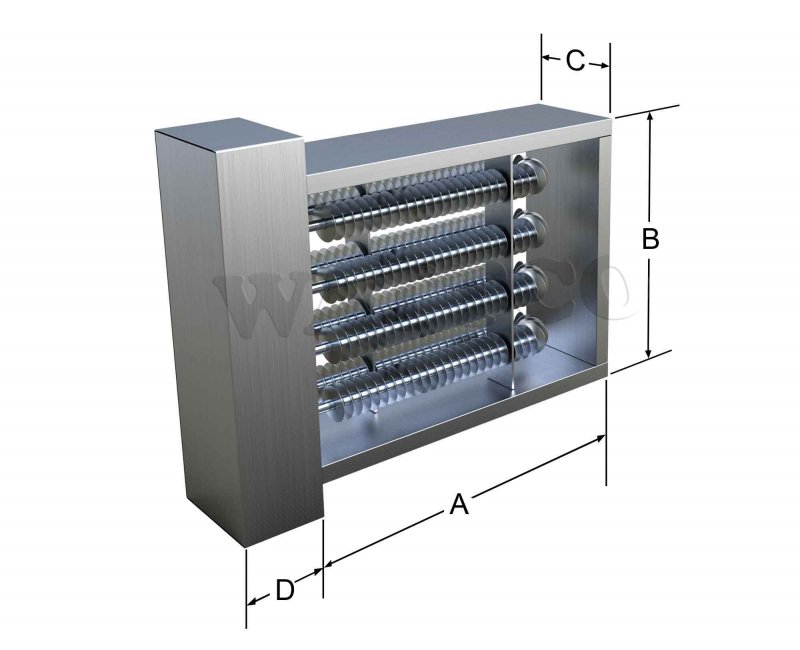
Duct Heaters for Process Air Heating
When it’s air you need to heat, duct heaters do the job. They warm moving air inside ventilation systems, drying equipment, ovens, and all sorts of industrial air-processing applications.
Mounted in the ductwork, they raise the temperature of the airstream as it flows past, giving you controlled, even heat delivery for anything from curing to drying to space process heating. For any operation that depends on warm, moving air, they’re the natural fit.
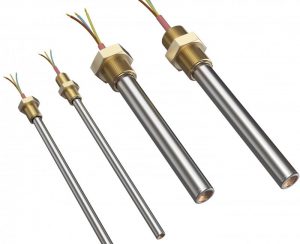
Cartridge Heaters for Localized Heating
Sometimes you need intense heat in a very specific spot, and that’s where cartridge heaters shine. They provide concentrated, localized heat from inside a drilled hole in the equipment itself.
You’ll find them packed into molds, dies, platens, sealing equipment, and packaging machinery, delivering precise heat exactly where the process happens. Their high heat output in a compact form makes them ideal for these tight, targeted applications where you need one specific area hot and controlled, not the whole machine.
How Custom Industrial Heating Systems Increase Productivity?
Here’s something worth saying plainly. A standard, off-the-shelf heater doesn’t fit every process, and forcing one in is how a lot of the problems in this article start. Real manufacturing conditions vary too much for one-size-fits-all.
A custom industrial heating system gets designed around your actual situation. The operating temperature you need to hit. The installation space you’ve got. The specific process medium, whether that’s water, oil, a corrosive chemical, or a gas. Your flow rate, tank capacity, and pressure conditions. Whether the environment is hazardous and needs special ratings. The right sheath materials for the fluid. And the voltage and power your facility supplies. Design around all of that, and you get better heat distribution, longer equipment life, safer operation, and higher output. Customization isn’t a luxury here. It’s often the difference between a heater that fights your process and one that quietly makes it better.
Common Industrial Heating Problems That Reduce Productivity
It helps to know the failure modes, because most of them trace back to a handful of avoidable causes. Slow heat-up drags out every cycle. Uneven temperatures create defects and scrap. Heater burnout stops the line cold. Excessive energy consumption inflates your costs month after month. Corrosion eats away at elements in the wrong environment. Scaling from hard water builds an insulating crust that makes the element overheat and fail. Incorrect watt density cooks the medium or shortens heater life. And poor control-system calibration lets temperatures drift out of spec without anyone noticing until the reject pile grows.
Notice the pattern. Almost all of these come back to improper heater selection, installation, operation, or maintenance. Pick the wrong heater for the medium and you get corrosion. Run too high a watt density and you get burnout. Skip the maintenance and scaling creeps in. The good news is that these are preventable. Choose the right heater for the real conditions, install it properly, run it within its limits, and maintain it, and most of these productivity killers simply never show up.
Final Thoughts
Industrial heating rarely gets the credit it deserves, but it touches nearly every productivity metric that matters. Faster heat-up and shorter cycles. Steadier temperatures and repeatable batches. Less downtime, higher quality, lower energy costs. Get the heating right and all of those improve together, quietly, every single shift.
The path there isn’t complicated, though it does take care. Match the heater to the medium and the conditions, size it properly, control it accurately, protect it, and maintain it. Where a standard unit falls short, build one around your actual process instead of forcing a compromise. Do that, and industrial heating stops being a hidden source of loss and becomes what it should be, a dependable engine for getting more good product out the door.
Wattco provides engineered industrial heating systems that help manufacturers maintain precise temperature control, reduce downtime, and improve process consistency. Our products are built to support higher productivity, reliable performance, and efficient operations across demanding manufacturing environments.