

How food and beverage plants can improve CIP heating and temperature control
On paper the CIP cycle looks fine. In the plant it’s a different story, taking too long to reach cleaning temperature, drifting once it gets there, or quietly burning through more energy than anyone budgeted for. It’s a familiar frustration on the floor, and the reflex is usually to reach for a bigger heater. But reliable CIP performance rarely comes down to one component.
The temperature, the flow, the heat loss, the controls, and the condition of the equipment all pull together, and a weak link anywhere shows up as a cleaning problem. What follows is a practical look at getting more out of your CIP heating without making the whole system needlessly complicated.
Why temperature control matters so much in CIP systems?
Cleaning leans on four things working together. There’s the time the cycle runs, the temperature it reaches, how concentrated the chemistry is, and the scrubbing action the flow provides. Weaken any one and the rest have to pick up the slack. Heating is what governs the temperature side directly, so once the heat turns inconsistent, that whole balance starts to wobble.
You end up running longer cycles, sometimes rewashing because the first pass didn’t quite do it, holding up production while the loop catches up, and spending energy you didn’t need to. Steady temperature isn’t a nice-to-have here, it’s what keeps the rest of the cleaning equation honest.
How food and beverage plants can improve CIP heating and temperature control?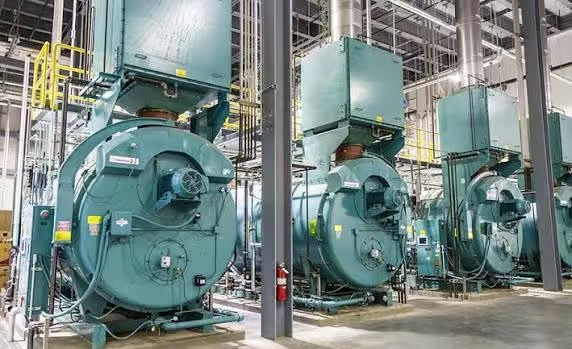
Start by understanding the real heating load
The single biggest mistake is sizing a heater off the tank volume and little else. A CIP heater has to serve the whole process, not just fill a number, so the honest picture takes in the water volume, the temperature it starts at, the temperature you need, how quickly you need to get there, the flow rate through the loop, and the heat you’ll lose along the way.
In smaller tanks or vessels, screw plug heaters can provide direct liquid heating, but the required kW still needs to be based on the actual volume, temperature rise, heat-up time, and process conditions rather than tank size alone. Miss a few of those and the heater that looked right on the quote struggles on the line. Get them down and you’re actually sizing for the job in front of you.
Heat-up load vs holding load
There are really two numbers hiding in a CIP system. The heat-up load is the power it takes to bring the cleaning solution up to temperature in the time you’ve got, and it’s usually the bigger of the two. The holding load is the smaller, steadier power needed to keep the solution there against the heat leaking out of the loop. Both matter when you’re choosing or reviewing a system, because sizing around only one leaves you either crawling to temperature or oversized for normal running.
Improve heat-up time without simply adding more kW
Slow heating doesn’t have to mean an undersized heater, and it’s worth pausing on that before you open the wallet. A whole range of things drag heat-up out without the heater being at fault. Maybe the insulation is letting warmth slip away, or scale on the element is choking heat transfer, or the circulation is weak, or the flow’s low, or heat is simply bleeding off down long piping. Any one of those can make a well-sized heater look feeble. So rather than jumping to more kW, it’s smarter to walk the full heating loop and knock off the cheaper, more likely suspects first.
Keep temperature consistent throughout the CIP loop
Here’s a trap worth knowing. The temperature you read at the heater outlet isn’t necessarily what’s happening at the far end of the system. On a large loop, with long piping and shifting flow, the solution can cool noticeably between the heater and the last spray head, so the point you’re trying to clean may be running colder than your gauge suggests.
For continuously circulating cleaning solutions, stainless steel inline heaters can provide direct heat within the flow path while supporting the material and sanitation requirements common in food-processing applications. Cleaning happens out there in the loop, not at the heater, which is why a single outlet reading can quietly mislead you into thinking everything’s fine.
Sensor placement can make a big difference
How useful a sensor’s reading is comes down to where it sits. It needs a spot that genuinely mirrors what’s happening in the clean, and in practice that usually means watching the supply and the return, not leaning on one alone. RTDs and thermocouples both do the job, but only if they’re positioned well and checked now and then for accuracy, because a sensor that’s drifted or badly placed sends the whole control system chasing a number that isn’t real. A quick habit of verifying sensor accuracy saves a lot of misdiagnosis.
Match flow rate and heating capacity
In a circulation heater, flow and heating capacity are joined at the hip, because the heater has to raise and then hold the temperature of solution moving through it. Push the solution through faster and each portion spends less time against the elements, so the temperature rise you can achieve drops. With industrial circulation heaters, flow rate and heating capacity are directly connected because the heater has to raise and maintain the temperature of cleaning solution while it continues moving through the loop.
A system that was sized nicely for one flow rate can start falling short if production changes later and the circulation requirement climbs, even though the heater itself never changed.
Watch for flow changes during operation
Flow has a habit of wandering from where you set it. Maybe a filter’s blocked, or a pump is labouring, or a valve got left part-closed, or the lines are fouling, or someone changed the process, and any of it can move the flow before anyone clocks it. That’s worth knowing, because a temperature grumble is sometimes a hydraulic issue in disguise. Before you pin a cold loop on the heater, check the flow is really where it belongs, since the true fault might sit well upstream of the heat.
Reduce heat loss before increasing heater size
A fair amount of CIP energy just leaks away, and running it to ground costs less than buying capacity. Heat drains out through uninsulated tanks, bare piping, exposed fittings, long transfer lines, and a cold room around them, all of which stretch heat-up and push up what it takes to hold temperature. Better insulation tends to earn its keep twice over, warming the solution faster and trimming the energy to keep it warm. So the sensible first step is tracing where the heat gets out before deciding a bigger heater is the answer, because plugging those leaks can fix it outright.
Prevent scale and fouling from hurting heat transfer
Scale, product residue, and chemical buildup on the heating surfaces behave exactly like insulation you didn’t ask for, sitting between the element and the solution and getting in the way of heat transfer. The result is a double hit, the solution warms more slowly while the element’s own surface temperature climbs, which is hard on the heater over time. Keeping those surfaces clean is one of the quieter ways to protect both performance and heater life.
Monitor heater performance over time
The early signs are subtle. Heat-up that’s slowly getting longer, an energy bill nudging upward, a temperature that won’t quite hold, a heater cycling more than before, each can be the system hinting at fouling or something else worth checking. Taking those little drifts as your cue to clean or inspect or service, rather than waiting for it to fail outright, is how a small niggle stays small.
Use better controls to avoid temperature swings
Accurate control does double duty, keeping the cleaning consistent and the energy bill sensible. The pieces that make it work are the temperature controller, the sensors feeding it, the contactors switching the load, SCR controls for smoother modulation where it’s warranted, and over-temperature protection standing guard. None of it needs gold-plating. It simply has to hold the setpoint without lurching, since a loop that sits quietly at temperature cleans far more dependably than one forever swinging.
Avoid overshoot and constant cycling
Overshoot and constant cycling usually trace back to a handful of causes, a heater bigger than the job needs, controller settings that aren’t dialled in, or a sensor sitting somewhere unhelpful. Any of those can have the system sailing past its setpoint or flicking on and off far too often. It’s a useful reminder that stable control often beats simply having extra heating power on tap, since raw capacity you can’t control smoothly tends to cause as many problems as it solves.
Design the CIP heating system around the process
The heater type ought to suit how the plant actually runs. Industrial circulation heaters are generally better suited to cleaning solutions moving continuously through a loop, while industrial immersion heaters make sense when the process calls for direct heating inside a tank or vessel.
Beyond that basic choice, the details matter, food-compatible materials, corrosion resistance, a watt density that suits the solution, the sanitary requirements the plant has to meet, the pressure and flow it’ll see, and easy access for inspection or replacement. This is where working with a manufacturer like Wattco early pays off, because those factors are far easier to build in than to bolt on later.
What plant teams should check when CIP heating performance drops?
When performance dips, it helps to run through a few quick checks rather than guess:
- Is the system reaching temperature more slowly than before?
- Is the return temperature lower than expected?
- Has flow rate changed?
- Are tanks and piping properly insulated?
- Is scale or fouling building up on the heater?
- Are temperature sensors reading accurately?
- Has the process volume or operating temperature changed?
- Is the heater cycling too frequently?
- Are controls and over-temperature devices working correctly?
- Has the CIP recipe or production process changed?
Common CIP heating mistakes that increase energy use and downtime
The recurring mistakes are worth naming. Oversizing the heater in the hope that brute force fixes everything. Ignoring heat loss and paying for it in energy. Putting sensors somewhere convenient rather than somewhere meaningful. Overlooking a flow-rate change that’s quietly throttling performance. Running on with fouled heating surfaces. And carrying on with heater specs that stopped matching the process a while ago. What ties most of these together is that CIP heating problems tend to creep in gradually as production conditions drift, which is exactly why a periodic review of the whole system is worth the time.
How to make CIP heating more reliable and efficient?
Pull it all together and the pattern is clear enough. Better CIP heating almost never comes from one heroic upgrade. It grows out of getting the heater capacity, the flow, the control, the insulation, the sensor placement, and the upkeep to pull together as one system. The most valuable habit a plant team can build is reading the real operating data, so the heat-up times, the supply and return figures, the energy draw, and the cycling frequency, because those numbers point right at where an improvement earns the most.
Final thoughts on improving CIP heating and temperature control
Reliable CIP heating isn’t about making as much heat as possible. It’s about getting the right temperature to the right place in the cycle, and keeping it there run after run. Size the heater properly, hold the flow steady, let the controls keep the line, use insulation to trap the heat where it belongs, and catch drift early through maintenance, and a food and beverage plant ends up cleaning more consistently on less energy and less lost time. Strike that balance and CIP quietly stops eating into your schedule.
FAQs about improving CIP heating and temperature control
What temperature should a CIP system operate at?
It depends on the wash and what you’re cleaning, so there’s no single figure. Caustic cleaning cycles commonly run somewhere in the region of 140°F to 185°F, while acid rinses and other steps sit lower, and a cold or ambient rinse has its own place in the sequence. The real answer comes from your cleaning chemistry and the soil you’re removing, so the target should follow the recipe rather than a generic number.
Why does a CIP system take too long to heat up?
An undersized heater isn’t always the reason for slow heat-up. It could be weak insulation, scale sitting on the element, poor circulation, a low flow, or heat slipping away through long piping, all of which drag the time out. Walking the whole heating loop before you reach for more kW is worthwhile, because more often than not the answer is sealing a leak or clearing a fouled surface, not extra capacity.
How does flow rate affect CIP heating performance?
A lot, because a circulation heater has to raise the temperature of solution as it moves through. Push the flow up and each portion gets less time against the elements, which lowers the temperature rise you can achieve. A system sized for one flow can fall short if production later increases circulation, so flow and heating capacity really need to be considered together rather than in isolation.
Can insulation improve CIP energy efficiency?
Definitely. Leave tanks bare and piping and fittings uninsulated and heat gets away, which lengthens heat-up and lifts the power required to hold temperature. Wrapping things properly usually shortens heat-up and trims the running cost at once, so tracking down and closing heat losses tends to beat adding capacity, and for a lot less money.
Why does CIP temperature drop during circulation?
Usually it’s heat slipping out between the heater and the far end of the loop, most of all on long runs with thin or missing insulation, and flow shifts or fouling can pile on too. That’s also why an outlet reading at the heater can look healthy while the return arrives cooler, so watching supply and return together gives you a more honest read on the loop.
How often should CIP heaters and temperature sensors be inspected?
It varies with your water, your product soil, and how hard the system works, but the smarter move is to let the data prompt you. Longer heat-up, higher energy use, temperatures that won’t hold, or more frequent cycling are all cues that it’s time to look. Building in routine checks of the heating surfaces and an occasional sensor-accuracy check keeps little drifts from growing into downtime.